

Private Limited Company, OPC, and LLP: Your Structure Determines Your Documents
Before you collect a single document, know which structure you are registering. The checklist differs — not dramatically, but enough to matter.
Private Limited Company (Pvt Ltd)
The most widely used structure for startups in India. Minimum two directors and two shareholders. Governed under the Companies Act, 2013 and registered through the MCA’s SPICe+ portal. If you are planning to raise funding, bring in co-founders, or build something that needs formal corporate standing, this is almost certainly the right structure. It carries the longest document checklist of the three — but the SPICe+ portal consolidates most of it into a single submission.
One Person Company (OPC)
Designed for solo entrepreneurs who want limited liability without needing a second member. An OPC is, legally, a private limited company — it is incorporated and governed under the same Companies Act provisions — but with a single shareholder and director. The one document category that separates it from a Pvt Ltd is the nominee. The law requires you to name someone who will take over the OPC if you pass away or become permanently incapacitated. That person must give formal written consent at the time of registration through Form INC-3. Only an Indian citizen above the age of 18 can be the member or nominee of an OPC.
Two limits worth knowing before you register: if your paid-up capital ever exceeds Rs. 50 Lakhs, or if annual turnover crosses Rs. 2 Crores, the OPC must be mandatorily converted to a Private Limited Company. Plan around those thresholds if your business is likely to grow quickly.
Limited Liability Partnership (LLP)
Governed by the LLP Act, 2008 — a different law, a different portal, a different set of forms from a Pvt Ltd. Minimum two designated partners. No Memorandum of Association. No Articles of Association. In their place is the LLP Agreement, which is both the most important document in an LLP registration and the one most commonly filed late. It must be submitted using Form 3 within 30 days of incorporation. Miss that deadline and the penalty is Rs. 100 per day with no upper ceiling. At 90 days overdue, that is Rs. 9,000. There is no grace period.
LLPs are popular among service businesses, consultancies, and professional firms because they carry fewer ongoing compliance requirements compared to a Pvt Ltd. If you are two or more professionals setting up a shared practice, an LLP is worth a serious look.
No Minimum Capital: There is no minimum paid-up capital requirement for a Private Limited Company, OPC, or LLP in India as of 2025. You can start with as little as Rs. 1. For an OPC, Rs. 1 Lakh is the standard convention for authorized capital, but it is not a statutory requirement.
Documents at a Glance: Side-by-Side Comparison (Pvt Ltd, OPC & LLP)
Before going into the full breakdown of each structure, use this table as a quick reference. It shows exactly which documents are required for which structure so you can see at a glance what applies to you.
Document / Requirement | Pvt Ltd | OPC | LLP |
PAN Card (Director / Partner) | Yes | Yes | Yes |
Aadhaar Card | Yes | Yes | Yes |
Address Proof (not older than 2 months) | Yes | Yes | Yes |
Residential Proof (not older than 2 months) | Yes | Yes | Yes |
Passport-size Photographs | Yes | Yes | Yes |
Digital Signature Certificate (DSC) | Yes | Yes | Yes |
DIN / DPIN | Yes (DIN) | Yes (DIN) | Yes (DPIN) |
Registered Office Utility Bill | Yes | Yes | Yes |
NOC from Property Owner | Yes | Yes | Yes |
Memorandum of Association (MoA) | Yes | Yes | No |
Articles of Association (AoA) | Yes | Yes | No |
LLP Agreement (Form 3) | No | No | Yes |
Nominee Consent — Form INC-3 | No | Yes | No |
Nominee PAN + Aadhaar | No | Yes | No |
SPICe+ Form (INC-32) | Yes | Yes | No |
FiLLiP Form | No | No | Yes |
DIR-2 (Consent to Act as Director) | Yes | Yes | No |
INC-9 (Statutory Declaration) | Yes | Yes | No |
Subscribers’ Sheet | Yes | Yes | Yes |
Section 1: Complete Documents for Private Limited Company Registration
A Pvt Ltd has three groups of documents. Personal KYC documents for every director and shareholder. Registered office documents. And the statutory forms filed through SPICe+. Every single one is submitted online — there is no physical filing at the ROC office anymore.
1.1 Identity and KYC Documents of Directors and Shareholders
Each proposed director and shareholder provides these individually. The Registrar of Companies checks every document, and any inconsistency between documents for the same person results in rejection. Not a warning. A rejection.
PAN Card — The primary identity document for every Indian director and shareholder — mandatory, no substitution. The name exactly as printed on your PAN card is the reference. Every other document you submit must carry that name in that exact format.
This is where most first-time applicants get caught. A director whose PAN card reads ‘Arjun R. Mehta’ submits an Aadhaar that reads ‘Arjun Ramesh Mehta’ and an address proof that reads ‘A. R. Mehta’. All three belong to the same person. The MCA system treats them as three different names and flags the application. The fix before filing takes five minutes. After submission, it means starting again. Before you collect any other document, write down the name exactly as it appears on your PAN card — including any initial, middle name, or abbreviation — and check every other document against it.
Aadhaar Card — Required for identity verification and OTP-based e-verification during the SPICe+ filing process. The Aadhaar number must be linked to an active mobile number — the MCA portal sends a one-time password to that number, and without it the form cannot be submitted.
This one catches co-founders off guard more than almost anything else. Someone changed their phone number months ago and never updated their Aadhaar link. Filing day arrives, the OTP goes to a number that no longer exists, and the submission stalls. Updating an Aadhaar mobile link requires a physical visit to an enrolment centre. It takes three to seven business days to reflect in the system. Check the Aadhaar-mobile link for every director at least a week before your planned filing date — not just your own.
Address Proof — A document that confirms your identity at an address, not older than two months from the date of filing. Acceptable documents: Voter ID Card, Passport, Driving Licence, or Aadhaar Card. The address on this document must match what you enter in the SPICe+ form.
Residential Proof — A document that confirms your current place of residence — separate from address proof, different acceptable documents, same two-month validity rule. Acceptable documents: Bank Statement, Electricity Bill, Telephone Bill, or Mobile Bill. These must show your name and current address clearly. A passbook page alone is not sufficient — you need a full bank statement. Both categories are required. Submitting address proof in place of residential proof is a frequent error that delays applications.
Passport-size Photographs — Two to three recent photographs per director and shareholder. Recent. Not from a passport application three years ago.
Digital Signature Certificate (DSC) — Mandatory for all proposed directors before anything else starts. The entire registration process runs online, and every form must be digitally signed using a Class 3 DSC — obtained from a government-approved certifying agency like eMudhra, Sify, or NSDL. It is issued on a physical USB token. Takes one to three business days. Apply for it the day you decide to register. It is the step most commonly left until the last moment, and it is the most common bottleneck in the entire timeline.
Director Identification Number (DIN) — A unique eight-digit number assigned by the MCA to every company director. For new companies, you can apply for DINs for up to three directors directly within the SPICe+ form. If you are incorporating with more than three directors who do not already have DINs, incorporate with three directors first and add the others through a separate filing after the Certificate of Incorporation arrives.
Address Proof vs Residential Proof: Address proof (Voter ID, Passport, Driving Licence, Aadhaar) establishes your identity at an address. Residential proof (Bank Statement, Electricity Bill, Telephone Bill, Mobile Bill) confirms where you currently live. Both are required, both must be under two months old, and they are not interchangeable. This is a distinction that most articles gloss over and most applicants miss.
1.2 Registered Office Documents
Every Private Limited Company must have a registered office address in India at the time of incorporation, or within 30 days of receiving the Certificate of Incorporation. These documents prove that address is real, accessible, and properly authorised.
And yes — a residential address is perfectly valid. Many startups in Bangalore register at the founder’s home. There is no legal requirement for a commercial premises, and there is no time limit on how long a company can keep a home address as its registered office. You need a utility bill for that address and, if you do not personally own the property, an NOC from the owner. That is it.
Utility Bill — Electricity, gas, water, or telephone — not older than two months, showing the full property address and the property owner’s name. If the bill is in a family member’s or landlord’s name and not yours, that is fine. The NOC handles the permission part.
No Objection Certificate (NOC) from the Property Owner — A formal written declaration from the property owner giving the company permission to use the address as its registered office. Required when the premises are not personally owned by the director. It must state the complete property address, the exact name of the company, and be signed by the person named on the utility bill.
The scenario that causes the most NOC rejections: a founder registers at their parents’ house. The electricity bill is in the father’s name. The NOC is signed by the mother — because she was available, or because the founder assumed it did not matter. The MCA checks the NOC signatory against the utility bill. They do not match. The application comes back. The person who signs the NOC must be the same person whose name appears on the utility bill. Not a spouse. Not a sibling. The exact same person. If that person is not available to sign, get the utility bill transferred to their name first — or use a different address.
Rent Agreement or Lease Agreement — Required when the office is on rented premises. If it is a co-working space, the NOC must come from the authorised co-working space provider, not a fellow member or a community manager who is not authorised to sign on the provider’s behalf.
Property Ownership Documents — If the director personally owns the property, a Sale Deed or Property Tax Receipt is submitted instead of a Rent Agreement.
1.3 Statutory and Constitutional Documents: SPICe+ Form, DIN Allotment, MoA, AoA and Required Declarations
These are the legal documents that formally constitute the company. All filed electronically through SPICe+. The SPICe+ form documents required — MoA, AoA, DIR-2, INC-9, and AGILE-PRO-S — are described below.
Memorandum of Association (MoA) — The foundational document. It states the company’s name, the state where the registered office is located, the business objectives, the liability clause, and the authorised capital. One thing most founders do not realise until later: any business activity outside the stated objectives requires a formal amendment. Think carefully about the objects clause before you finalise it. The MoA is a public document — anyone can view it through the MCA portal after registration. Filed electronically via Form INC-33.
Articles of Association (AoA) — The company’s internal rulebook. Board meeting procedures, voting rights, share transfer rules, dividend policies. Unlike the MoA, which defines what the company does externally, the AoA governs how it runs internally. Filed electronically via Form INC-34.
DIR-2 — Consent to Act as Director — A signed declaration from each proposed director confirming their willingness to take on the role and that they are not disqualified under the Companies Act. Must be signed individually by each director.
INC-9 — Statutory Declaration — A declaration confirming all Companies Act requirements have been met for incorporation. For companies with up to 20 subscribers who already have valid PAN and DIN, this form is auto-generated and auto-filled by the SPICe+ system — it only needs a digital signature. You do not need to separately draft it.
AGILE-PRO-S Form — Filed alongside SPICe+. A single linked submission that simultaneously applies for GST registration, EPFO, ESIC, a business bank account with a partner bank, and a Shops and Establishment licence. Using AGILE-PRO-S at incorporation is simply more efficient than filing each of these separately afterwards.
SPICe+ Form (INC-32) — The master form for all Private Limited Company and OPC registrations. Part A handles name reservation. Part B covers the full incorporation application — DIN allotment for up to three new directors, links to eMoA, eAoA, INC-9, and AGILE-PRO-S. Parts A and B can be filed together or separately. If filed separately, the approved name is reserved for 20 days, within which Part B must be submitted. If the name is rejected in a combined filing, one free re-submission is allowed.
Section 2: Complete Documents for One Person Company (OPC) Registration
Every single document listed in Section 1 applies to an OPC without exception — PAN card, Aadhaar, address proof, residential proof, photographs, DSC, DIN, registered office documents, NOC, MoA, AoA, DIR-2, INC-9, AGILE-PRO-S, and SPICe+. All of it. The additions below are specific to the fact that an OPC has only one member.
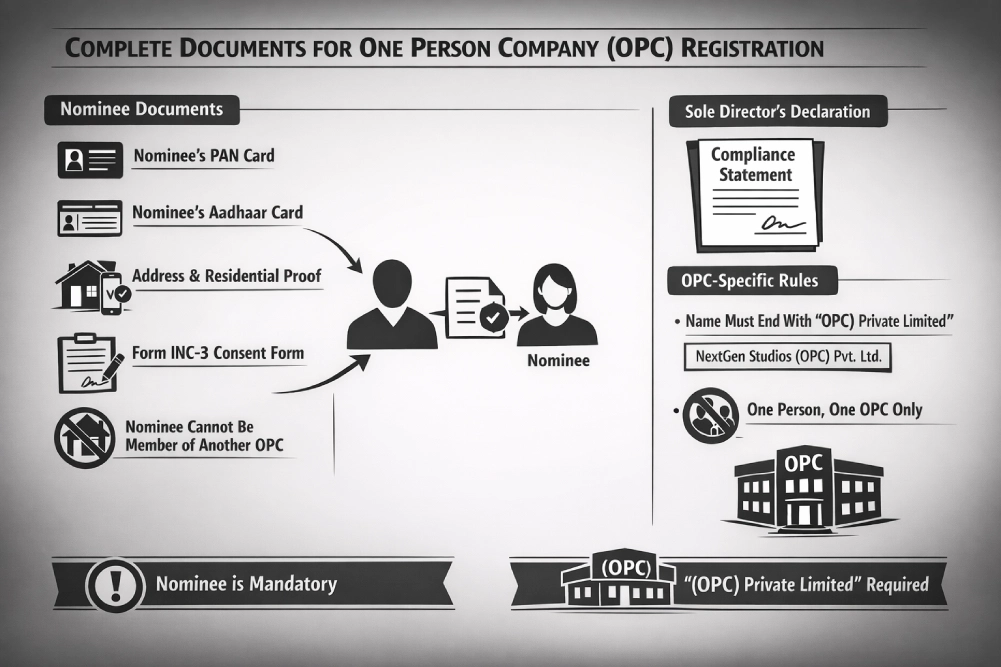
2.1 Nominee Documents — The OPC-Specific Category
Because the entire company rests on one person, the Companies Act, 2013 requires a nominee at the time of registration. The nominee is the person who takes over ownership and management if the sole member dies or becomes permanently incapacitated. This is not optional. Without the nominee documents, the OPC application cannot proceed.
Nominee’s PAN Card — The name on the nominee’s PAN card must match the name used in all other nominee documents submitted. Same consistency rule as for the director.
Nominee’s Aadhaar Card — Must be linked to an active mobile number for OTP verification during the filing process. Check this before the filing date.
Nominee’s Address Proof and Residential Proof — Same two-document requirement as for the director. An address proof document and a residential proof document — both not older than two months.
Form INC-3 — Nominee’s Written Consent — The formal consent form through which the nominee agrees to take on the role. Must be filed with the SPICe+ application. No form, no OPC registration.
One thing that founders often miss: the nominee cannot be the sole member of another OPC. If you plan to nominate a friend or sibling, confirm first that they are not already the sole member of another registered OPC. If they are, they are disqualified. You need to find someone else — or ask the existing OPC member to change their nominee before proceeding. This comes up more often than you would expect among founders who run businesses with people in their circle who have multiple ventures.
Sole Director’s Declaration — A written declaration by the sole director confirming compliance with the OPC provisions of the Companies Act, 2013. Filed in addition to the standard INC-9.
2.2 OPC-Specific Rules That Affect Your Documents
The company name must end with ‘(OPC) Private Limited’ — for example, ‘NextGen Studios (OPC) Private Limited’. This is a statutory requirement. The MCA rejects names that do not include this suffix. Check the name format before you start preparing any documents.
One person cannot be a member of more than one OPC at any time. If you already hold an OPC and want to start a new venture, it must be incorporated as a Private Limited Company with a second member — not as a second OPC under your name.
Section 3: Complete Documents for LLP Registration in India
An LLP runs on different rails. The LLP Act, 2008. The MCA V3 portal. The FiLLiP form. Different rules, different forms, different consequences for missing deadlines. If you have been reading through the Pvt Ltd section and assuming it all carries over — most of it does, but not all of it.
3.1 KYC Documents of Designated Partners
PAN Card — Required for every Indian partner. The name exactly as printed on the PAN card must be used consistently in every form, every document, and in the LLP Agreement itself. The LLP Agreement is a legal contract — a name inconsistency in the agreement creates problems during notarisation and later filings.
Aadhaar Card — Accepted as address proof for individual Indian partners. If your Aadhaar still carries an old address, update it through the UIDAI portal before starting registration. The address on your Aadhaar is cross-checked against other documents. An outdated address adds unnecessary friction.
Address Proof — Not older than two months from the date of filing. Voter ID Card, Passport, Driving Licence, or Aadhaar Card.
Residential Proof — Not older than two months. Bank Statement, Electricity Bill, Telephone Bill, or Mobile Bill — must clearly show the partner’s name and current address.
Passport-size Photographs — Two to three recent photographs per designated partner.
Digital Signature Certificate (DSC) — Class 3 DSC for at least one Designated Partner. In practice, all Designated Partners should get their DSC at incorporation — every LLP filing after this point, including annual returns and partner change forms, requires digital signatures. Getting it done now is simply more practical.
DPIN — Designated Partner Identification Number — The LLP equivalent of a DIN. Every Designated Partner must hold a valid DPIN. If a partner already holds a DIN from a company directorship that same number serves as their DPIN for the LLP— no separate application needed.
3.2 Registered Office Documents for the LLP
Identical requirements to a Pvt Ltd — utility bill not older than two months, NOC from the property owner if the premises are not owned by a partner, and a rent or lease agreement if the office is rented. These can be submitted at incorporation or within 30 days of receiving the Certificate of Incorporation.
A residential address is equally valid for an LLP’s registered office. The utility bill must be in the name of the person who owns the property. The NOC must be formally drafted and signed by that same person. Same rules, same common mistakes.
3.3 FiLLiP Form, LLP Agreement and All Documents Required for LLP Registration
Form FiLLiP — Form for Incorporation of LLP — The master form for all LLP registrations on the MCA V3 portal. Handles name reservation for up to two proposed names, DPIN allotment, and the incorporation application in a single submission.
There is a limit in FiLLiP that catches multi-partner LLPs off guard. FiLLiP can allot new DPINs for a maximum of two people in one application. If you have three partners who all need new DPINs — none of them holding an existing DIN or DPIN — FiLLiP cannot process all three at once. The solution: incorporate the LLP with two partners first, receive the Certificate of Incorporation, then add the third partner through Form 4. It is an extra step, but it is the correct process. Knowing this before you start saves a rejected application.
RUN-LLP — Reserve Unique Name for LLP — An optional separate name reservation step before FiLLiP. Around 20% of LLP name applications get rejected by the MCA — usually because the proposed name is too similar to an existing registered entity or trademark. The rejected name fee is not refunded. Spending 30 minutes on the MCA name search tool and the trademark registry at ipindia.gov.in before filing is genuinely worth it.
LLP Agreement — The most important document in the entire LLP registration. It defines every partner’s rights and duties, capital contribution amounts, profit and loss sharing ratios, the process for admitting or exiting partners, dispute resolution procedures, and day-to-day operational rules. It must be executed on non-judicial stamp paper of the correct value — which varies by state (see the stamp duty table below). All partners must sign it. It must be notarised. And it must be filed with the MCA using Form 3 within 30 days of the Certificate of Incorporation.
A note on getting it drafted properly: we have seen LLPs where partners wrote the agreement themselves from a free template they found online, with a generic profit-sharing clause and no exit procedure. Two years later, one partner wants to leave. There is nothing in the agreement about how to value their contribution or what they are owed. What follows is an expensive, relationship-ending legal process. The cost of having a Company Secretary or business lawyer draft a proper LLP Agreement at the start is a fraction of what a poorly drafted one costs when something goes wrong.
Subscribers’ Sheet — Lists the capital contribution of each partner with their signatures. Confirms financial commitment. Submitted as part of the FiLLiP filing.
Form 9 — Consent to Act as Designated Partner — The LLP equivalent of DIR-2. Each Designated Partner signs this form to formally accept their role. Attached to the FiLLiP submission.
30-Day Filing Deadline — No Exceptions: The LLP Agreement must be filed using Form 3 within 30 days of the Certificate of Incorporation. The penalty for late filing is Rs. 100 per day with no ceiling and no grace period. At 60 days overdue, that is Rs. 6,000. At 180 days, Rs. 18,000. Draft the LLP Agreement the same week you apply for incorporation so it is ready to file the day the COI arrives.
Before printing the LLP Agreement, check the stamp duty applicable in your state. The table below covers rates across all major states. These rates are set by state governments and are subject to revision — always verify with a Company Secretary or the official state revenue department before printing.
State | Stamp Duty on LLP Agreement | Notes |
Karnataka | Rs. 500 flat for capital up to Rs. 5 Lakh; higher slabs above | Verify with Karnataka Stamps Act before printing |
Maharashtra | Rs. 500 per Rs. 1 Lakh of capital contribution (max Rs. 50,000) | One of the highest in India |
Delhi / NCT | Rs. 100 flat or based on agreement value | Popular for LLP incorporation — lower duty |
Gujarat | Varies by capital contribution slab | Check current Gujarat Stamp Act schedule |
Tamil Nadu | Rs. 300 per Rs. 1 Lakh of capital (max Rs. 60,000) | Confirm with state authority |
West Bengal | Rs. 100 to Rs. 10,000 based on capital | Tiered slab structure |
Telangana | 1% of capital contribution (max Rs. 20,000) | |
Rajasthan | Rs. 200 flat for capital up to Rs. 5 Lakh | |
All Other States | As per respective State Stamp Act | Verify with a local CS before execution |
Note: Stamp duty rates are amended by state governments periodically. Verify the current applicable rate with a Company Secretary or from the official state revenue department before printing the LLP Agreement.
Section 4: Documents for NRI and Foreign National Directors or Partners
India allows NRIs and foreign nationals to become directors, shareholders, and designated partners in Indian companies and LLPs. The core registration process is the same. The document requirements differ in a few specific areas.
4.1 For Foreign National Directors or Shareholders in a Pvt Ltd or OPC
Passport — The primary identity document for all foreign nationals — both the front page and the address page. The passport must be notarised and apostilled in the country where it was issued, or attested by the Indian Embassy or High Commission in that country. If the passport is from a country that is not a signatory to the Hague Apostille Convention, consularisation through the Indian Embassy is required instead.
Overseas Address Proof — A driving license, bank statement, residence card, or any government-issued document with the applicant’s address. Unlike the two-month rule for Indian documents, overseas address proof is accepted up to one year old. If the document is in a language other than English, a notarized or apostilled translation into English must accompany it.
Indian Address Proof for Foreign Nationals Residing in India — If the proposed director is currently in India at the time of incorporation, they must also provide an Indian address proof — a utility bill or bank statement not older than two months — along with a copy of their valid Indian visa.
For any Private Limited Company, at least one director must be a resident of India — defined as someone who has stayed in India for at least 182 days in the preceding calendar year. This is a legal requirement under the Companies Act, 2013 and it cannot be waived. If none of the proposed foreign national directors meet this threshold, an additional Indian resident director must be added before registration can proceed.
Land-Border Country Security Clearance: If a proposed director or shareholder is a national of a country that shares a land border with India — China, Pakistan, Bangladesh, Nepal, Bhutan, Myanmar, or Afghanistan — prior security clearance from the Ministry of Home Affairs is mandatory. This clearance must be obtained before the SPICe+ application is filed. The process takes several weeks. Plan for it well in advance.
4.2 For Foreign Nationals as LLP Partners
The same passport, overseas address proof, and translation requirements apply. At least one Designated Partner must be an Indian resident. If the foreign partner is a corporate entity rather than an individual — for example, a foreign company investing in an Indian LLP — two additional documents are required: the Certificate of Incorporation of that foreign company (notarised and apostilled), and a Board Resolution authorising the investment and nominating a specific individual as the Designated Partner on its behalf (also notarised and apostilled).
Foreign nationals investing in Indian companies or LLPs must comply with FEMA and the FDI policy administered by DPIIT. As of 2025, 100% FDI under the automatic route is permitted in LLPs in sectors where 100% FDI is otherwise allowed — IT services, consulting, and e-commerce are examples. Sectors that require government approval for FDI need that approval before incorporation. Check the current DPIIT sectoral list. It changes.
Section 5: What You Need to Do After the Certificate of Incorporation Arrives
Most guides stop at the COI. This one does not. Because the COI is not the end — it is the start of the compliance calendar, and there are several registrations that must be completed before you can actually operate the business properly.
Certificate of Incorporation (COI) — Issued by the Registrar of Companies after successful registration. Contains the Corporate Identification Number (CIN) for a company or LLPIN for an LLP. Required for everything that follows — bank account, GST, contracts, every regulatory filing from this point on.
PAN and TAN — As of 2025, both are automatically issued with the COI through SPICe+ and FiLLiP — sent to the registered email address. The physical laminated PAN card is no longer required. The PAN in the COI email is legally valid.
GST Registration — Mandatory if annual turnover is expected to exceed Rs. 20 Lakhs. Rs. 10 Lakhs for certain Northeastern and special category states. For e-commerce businesses, mandatory regardless of turnover. AGILE-PRO-S filed during SPICe+ can initiate this at incorporation.
Business Bank Account — Opening a current account requires the COI, MoA and AoA or LLP Agreement, the company’s PAN card, KYC of authorised signatories, and a board resolution or partner authorisation letter. Call the bank’s business account team before visiting — requirements vary between banks. Some banks also ask for the Shops and Establishment Certificate before opening the account.
MSME / Udyam Registration — Free and takes under 30 minutes. If your business qualifies under MSME classification, this registration gives you access to collateral-free loans under government schemes, priority sector lending, subsidized trademark and patent registration fees, and the MSME Samadhaan portal for chasing delayed payments from buyers. Needs only the company PAN and the Aadhaar of the authorised signatory.
Shops and Establishment Act Registration — Required in most states for businesses operating from commercial premises — and in many states, even for home-based businesses with employees. For Bangalore-based businesses, this is issued by the BBMP through the state’s online portal. Certain banks also ask for this before opening a current account.
EPF and ESI Registration — EPF becomes mandatory once you employ 20 or more workers. ESI applies when you have 10 or more employees in certain sectors. Both can be initiated through AGILE-PRO-S at the time of incorporation.
Professional Tax Registration — Karnataka, Maharashtra, West Bengal, and several other states levy Professional Tax. For companies in Bangalore, registration is done with the Commercial Taxes Department of Karnataka.
Import Export Code (IEC) — Required if you plan to export services or goods, or import into India. Issued by the Directorate General of Foreign Trade. Needed for customs clearance, receiving international payments through banks, and using export promotion schemes.
Section 6: Eight Document Errors That Get Applications Rejected — And What to Do Instead
Every one of these is preventable. Every one of them has happened to founders who thought they were prepared.
- Name mismatch across documents — The name on your PAN card is the reference name. Every other document — Aadhaar, address proof, residential proof, and every MCA form — must carry that name in that exact format. This includes whether a middle name is included or abbreviated, whether an initial has a full stop after it, and the order of first and last name. Check this for every director and partner before uploading anything. One inconsistency across any two documents for the same person returns the entire application.
- Address proof or residential proof older than two months — The two-month validity is calculated from the date of MCA filing — not the date you collected the document. If your filing gets delayed by two weeks after you gathered the documents, go back and check the dates. A utility bill dated 63 days ago at the time of submission is an outdated utility bill. Keep a one-month buffer when collecting these documents if there is any chance the filing date might slip.
- An informally drafted NOC — The NOC must be a formal written document — full property address, exact company name, the owner’s signature. The signatory must be the same person named on the utility bill. Not a family member. Not a neighbour. Not someone who manages the property on their behalf. The exact same person. This is the most specific and the most frequently failed verification step in the registered office document review.
- Blurry or low-resolution document scans — The MCA portal has file size and quality requirements. Blurry phone photos get flagged during technical verification. Use a flatbed scanner or a quality scanning app that produces clear, legible PDFs. Check each file on a desktop before uploading. For colour documents, scan in colour. For text documents, minimum 200 DPI. A 10-minute scan check before submission saves days of delay.
- LLP Agreement filed after 30 days — This is the most expensive mistake on this list because it has no ceiling. Founders who focus on incorporation, celebrate receiving the COI, and then take their time on the LLP Agreement find out about the penalty weeks later. Start preparing the LLP Agreement the day you begin the incorporation process so it is ready to file the moment the COI arrives.
- Authorised capital figures inconsistent across forms — The number in the MoA must exactly match what is entered in the SPICe+ form and what appears in the AoA. Decide the authorised capital figure before you start preparing any document and write it down. Use it without variation across every form.
- DSC not mapped to the MCA portal — Getting a DSC and mapping it to your MCA user account are two separate steps. Many applicants do the first and forget the second, then find on filing day that the digital signing fails. Log into the MCA portal and complete the mapping before the filing session starts. If a DSC has expired, it must be renewed and remapped before any form can be signed.
- Wrong stamp duty value on the LLP Agreement — The LLP Agreement must be printed on non-judicial stamp paper of the correct value as set by the stamp duty rules of the state where the registered office is located. An agreement on incorrect-value stamp paper is not legally valid and must be reprinted. The stamp duty table in Section 3 of this article covers the current rates for all major states.
Section 7: The Registration Process Step by Step — Where Each Document Fits
Knowing what documents you need is half the picture. Knowing when each document enters the process is the other half. Here is the full timeline in order.
- Apply for DSC. Before anything else. A Class 3 Digital Signature Certificate from a government-approved agency — eMudhra, Sify, or NSDL. Takes one to three business days. Apply the moment you decide to register, not on the day you plan to file. Use this waiting time to start gathering all KYC documents, registered office documents, and the NOC.
- Reserve the company or LLP name. For Pvt Ltd and OPC: SPICe+ Part A, or file both parts together. For an LLP: RUN-LLP or the FiLLiP form. Submit two proposed names. Search the MCA name availability tool and the trademark registry at ipindia.gov.in before filing — rejected name fees are not refunded. Name approval takes one to five working days.
- Prepare constitutional documents. For Pvt Ltd and OPC: draft the MoA and AoA. For an LLP: draft the LLP Agreement with the help of a Company Secretary. Errors in these documents require a formal amendment process after incorporation, so take the time to get them right before filing.
- Verify all documents before touching the portal. Every document current. Every document in PDF format and within MCA file size limits. Names consistent across all documents for every person. This step is worth doing with the comparison table from this article in front of you, going line by line.
- File the incorporation form. For Pvt Ltd and OPC: SPICe+ Part B together with AGILE-PRO-S, eMoA, eAoA, INC-9, and DIR-2 for each director. For an LLP: FiLLiP together with the Subscribers’ Sheet and Form 9 for each Designated Partner. Pay the government fee — see the fee table in Section 9 of this article.
- Track the application status daily. Log into the MCA portal and check. If a re-submission notice (RESUB) arrives, respond within the time allowed. Most RESUB notices come for minor documentary reasons: an address proof date, a name inconsistency, a NOC signatory mismatch. Respond promptly — repeated delays can result in full rejection.
- Receive the Certificate of Incorporation. The ROC issues the COI by email along with the CIN or LLPIN, PAN, and TAN. Timeline: Pvt Ltd and OPC typically 7 to 15 working days. LLP: 10 to 15 working days. Both assume first-submission clean filing.
- For LLPs only — file Form 3 with the signed LLP Agreement within 30 days of the COI. Executed on correct stamp paper, notarized, all partners signed. Filed through the MCA V3 portal.
- Complete post-registration steps: business bank account, GST if applicable, MSME Udyam, Shops and Establishment registration, EPF and ESI if you have employees.
Registration Timeline: Pvt Ltd and OPC: 7 to 15 working days on a clean first submission. LLP: 10 to 15 working days. A name rejection adds 3 to 7 days. A RESUB notice adds 5 to 10 days. Build a two-week buffer into any business launch that depends on incorporation being complete.
Section 8: Things People Ask Before They File — Answered Directly
These come up constantly. Answering them here means you do not need to search for them separately.
On the DSC
Class 3 only — Class 1 and Class 2 DSCs are not accepted on the MCA portal. The DSC arrives on a physical USB cryptographic token. That token must be plugged into your computer when signing forms — the driver software must be installed on the same machine. Mac users: confirm token compatibility with your certifying agency before purchase. Some tokens have limited Mac support and this only becomes apparent at the worst possible time.
On Company Names
A name must not be identical or deceptively similar to an existing registered company, LLP, or trademark. Names containing words like ‘India’, ‘National’, ‘International’, ‘Bharat’, or ‘Bank’ require additional approval. Religious references and government-affiliation suggestions are also restricted. Run the name through the MCA search tool and the trademark registry — both — before settling on anything. Twenty minutes of checking saves a rejection.
On Using a Home Address as the Registered Office
Fully acceptable. No legal restriction. Many companies in Bangalore operate permanently from the founder’s residential address without any issue. If you do not personally own the property, you need the property owner to sign an NOC. That is the only condition. If you later move to a commercial office, the registered office can be changed through a board resolution and an MCA filing.
On Minimum Capital
There is no minimum paid-up capital for a Pvt Ltd or LLP in India as of 2025. For an OPC, Rs. 1 Lakh authorized capital is the convention, but it is not a statutory floor. Authorized capital is the ceiling on share issuance — not the amount you must put into the company. Set it at a level that makes sense for your business structure and expected growth.
On the SPICe+ Process
SPICe+ replaced the older INC-29 form and multiple separate filings with one integrated submission. Through it, a company can receive its incorporation approval, PAN, TAN, GST registration, EPFO and ESIC registration, a business bank account with a partner bank, and a Shops and Establishment license — all from one form. Not all of these are mandatory at filing, but triggering them through AGILE-PRO-S at incorporation is simply more efficient. The portal allows saving a draft and returning to it later, which is practical when you are coordinating documents from multiple directors across different cities.
On the LLP Agreement
It is the governing charter of the business, not a compliance formality. It determines how profits are shared, how losses are borne, what happens when a partner wants to exit, and how disputes are resolved. A template agreement might satisfy the MCA. It will not protect you when something goes wrong between partners. Have it drafted by a Company Secretary or a business lawyer. The cost is modest. The alternative is not.
On NRI and Foreign National Directors
The entire incorporation process can be completed remotely. Notarised and apostilled documents can be sent by courier or uploaded digitally where the MCA portal permits electronic submissions. The one thing that cannot be waived: at least one director of a Pvt Ltd and at least one Designated Partner of an LLP must be an Indian resident — someone who has lived in India for at least 182 days in the previous calendar year. Plan the directorship structure around this before you start.
Section 9: MCA Government Filing Fees for Company and LLP Registration (2025)
The government filing fee for company registration is based on authorised capital for a Pvt Ltd or OPC, and on capital contribution for an LLP. These are MCA fees only. Professional fees charged by a Company Secretary or CA for their services are separate. The table below is based on the fee schedule as of 2025 — verify the current amounts at mca.gov.in before filing, as the MCA revises these periodically.
Authorised / Contributed Capital | Pvt Ltd Fee | OPC Fee | LLP Fee |
Up to Rs. 1 Lakh | Rs. 200 | Rs. 200 | Rs. 500 flat |
Rs. 1 Lakh to Rs. 5 Lakh | Rs. 300 | Rs. 300 | Rs. 500 flat |
Rs. 5 Lakh to Rs. 10 Lakh | Rs. 400 | Rs. 400 | Slab-based — see MCA calculator |
Rs. 10 Lakh to Rs. 50 Lakh | Rs. 500 per Rs. 10 Lakh (max Rs. 2,000) | Same as Pvt Ltd | Slab-based |
Rs. 50 Lakh to Rs. 1 Crore | Refer MCA portal | Refer MCA portal | Refer MCA portal |
Above Rs. 1 Crore | Refer MCA portal fee calculator | Refer MCA portal | Refer MCA portal |
Note: The amounts above are government registration fees only. Professional service fees charged by a CA or CS for preparing and filing the incorporation documents are not included. Always verify current applicable fees through the fee calculator on mca.gov.in before filing.
Before You File
The documents required for company registration in India come down to three things: who you are, where your office is, and what kind of company you are forming. Get those three groups right — with consistent names across every document, dates that are within the two-month window on the day you file, an NOC signed by the correct person, and your DSC mapped to the MCA portal before you start the session — and registration is a clean process.
The mistakes that cause rejections are almost never about missing something obscure. They are about the name being spelled one way on the PAN card and another way on the Aadhaar. A utility bill that is 65 days old instead of 59. An NOC signed by the wrong family member. Small things. But the MCA system does not distinguish between a small error and a large one.
One final point worth making: for LLPs, the 30-day deadline for filing the LLP Agreement is not a guideline. It is a hard deadline with a penalty that has no ceiling. Draft the agreement before you even apply for incorporation. File it the week the COI arrives. There is genuinely no reason to let that clock run.
Run through this before you file:
- Names are exactly identical across PAN card, Aadhaar, address proof, residential proof, and all MCA forms — for every director and partner.
- Address proof and residential proof are under two months old on the actual filing date.
- The NOC is formally drafted and signed by the person named on the utility bill.
- DSC is obtained and mapped to the MCA portal before the filing session starts.
- For LLPs: LLP Agreement is drafted, on correct-value stamp paper, and ready to file within 30 days of the COI.
- Authorised capital figures are identical across the MoA, AoA, and SPICe+ form.
Your company is registered. Now build the brand.
The first thing investors, clients, and partners check after your COI arrives is your website and your investor pitch deck. Creative Nexus India builds both — from scratch — for newly registered startups and growing businesses across India.